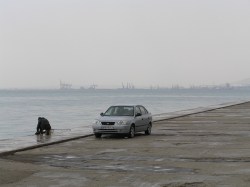
These few pictures are taken on the newly refurbished waterfront of Thessaloniki that ends with the brick building of the city Concert Hall. From the opposite side you can see the new extension of the Concert Hall in light grey and the cranes of the harbour on the background of the city landscape.
The historical harbour has been partially converted into leisure area next to the city centre, hosting among others the film museum, the museum of photography, a contemporary art museum, restaurants and bars in the old warehouses, beside the port authority.
Altogether it makes a very lively relationship between the city and the sea, based on leisure and cultural activities, looking for a balance between buildings and uses inherited from the past and some fashionable landscaping accents.
Visiting Greece /1 Thessaloniki
Visiting Greece in these days is supposed to have a fully different taste and meaning as it used to have in the years before. The land of the sun, the cradle of western civilisation with its hospitality, cristal clear seewater and olive trees has suddenly become the land of the deepest financial and economic crisis the European Union ever faced (well… not yet faced!).
At the end of Mai 2011 the partners of the Urbact Network LINKS gathered together in Veria, in the central Macedonian region, 60 Km east from Thessaloniki. We had the chance to visit these places from the privileged perspective of an invited guest, through guided tours to the monuments and heritage of the historical city, beside that I did not give up some random walks around and conversation about current troubles and worries.
Apart from the perfect organisation of the workshop, the extraordinary reliability and efficiency of its organisation and management, my first finding was the difficulty to see around traces of this tremendous crisis. Talking to the guests when arriving to the city it became clear that the crisis was badly affecting the real economy, many jobs were lost, wages and pensions cut down, shops and firms closed. But on the other side there is a large part of the population who luckily has not been affected by the crisis and even if yes, they do not like to complain about it and are prepared to react. What is affecting everybody is a great sense of impotence against this phenomenon, a growing anger that could not find yet a clear objective, after realising of having been cheated for so many years.
As a matter of fact a distinctive feature of this crisis is that you don’t know who is responsible for it. The Greek Governments? Yes for sure, but only partly. The Banks of the big EU countries who bought the Greek debt to earn on their unaffordable interests rate? Yes, also, but who and where are they? The Germans (Government and population) who are hesitating to give credit to Greece creating panic on the markets, before finally agreeing to do so? Yes, but they have also some good arguments to be hesitating. The EU Council who is deciding every day something different, everything but a clear exit strategy? Yes, but again, who are they really and who or what do they represent, if not us?
As a result, in the age of information, we are all very well informed, but it seems not to help to understand what we have to do, and not even who to protest against. And finally the picture of things these information gives us do not seem to correspond to reality.
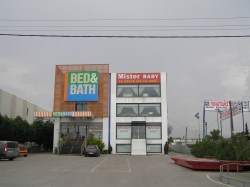
After all I must say I enjoyed my stay in greek Macedonia very much. The country, the people and the situations I found were pretty the same I remembered from my previous trips. The pictures I like to post are streetviews taken along the way from the airport to the center of Thessaloniki.
More detailed information about the workshop in Veria will be published on the Urbact website soon.
Europe, Danube and Water – Efap Conference in Budapest
In the framework of the official programmes of the Hungarian Presidency of the Council of the European Union the European Forum for Architectural Policies has organised an international conference in Budapest between 4th and 7th of May. Sara Van Rompaey represented the Belgian Chamber of Architects and the Architetcts’ Council of Europe. She sent me a short note about the event and some slides that I am very glad to publish here.
The European Forum for Architectural Policies aims to foster and promote architectural policies in Europe, bridging public governance, profession, culture and education. One means to achieve this aim is to provide a forum at its biannual conference for continuous exchange of information and dialogue on architectural policy, to promote the creation and operation of national architectural policies by presenting working national, and in some cases local architectural policies, the way in which they were created and implemented, and the results that they produced.
The main topic of the Budapest conference has been water and the River Danube, revealing the architectural and spatial planning relevance of the European Danube Region Strategy. The international conference provided the opportunity to direct attention, in a European context, to the issues of our global world that require common solutions of urban planning and architecture.
The conference was structured around 3 topics.
Europe, Hungary, Architectural policy: Make “Papers” Work!
The conference gave insight into the cultural relevance of the Europe 2020 Strategy and the concept of implementing the principles and strategies of the Leipzig Charter and presented the EU Council Conclusions on architecture and sustainable development.
Furthermore a comparative analysis gave an account of the architectural policies that are already working in the countries of Europe and provided information about the situation of the Hungarian architectural policy as well.Danube and Water: Grab the Chance!
The conference provided an overview of the role and importance that the River Danube has in the Central European region, followed by a presentation on the European Danube Region Strategy.Innovation for Sustainability: Build for People in a Different Way!
It is necessary to renew attitude and mindset in town- and regional planning. The issues addressed included the interdependence of cities and their regions, environment-conscious water management and landscape use. Working European examples have been used to show how to shape the environment in a harmonious manner and on a humane scale focusing on real quality of life. Good examples will show that former construction methods and abandoned buildings can be creatively adapted and reutilised.In addition to the representatives of the European Parliament and the European Commission, international and Hungarian lecturers and participants were invited from all areas of the profession of architecture in its broadest sense.
Further comprehensive information in English and Hungarian language at the Budapest Conference website www.efap.mek.hu
Weinhaus Grebel in Koblenz Güls
Cities are also made by their surroundings and their relationship with nature. To this extent some cities are much luckier than other, if, for example it takes ten minutes by bus or by train to reach a village like Güls in the middle of magnificent vineyards. I booked at Weinhaus Grebel via internet, hoping to find a nice and convenient place. I found much more: hospitality, comfort and a little but unforgettable experience of a special place. Pictures may give you an impression about it.
BUGA transforms Koblenz
Despite the striking location at the confluence between Mosel and Rhein, Koblenz is a very reserved city. I have to admit that I did not even visit this city during the 6 years I lived in Darmstadt, although it was very near, between Frankfurt and Trier.
Today we should better say Koblenz it has been for many decades a silent and quiet city, as the national gardening and landscaping fair “Bundesgardenschau” (BUGA) is aiming at modifying this attitude and reputation. “BUGA verwandelt Konstanz” is the motto of this wonderful event that is regularly organized by the Environmental Ministry.
Through the attention raised by flowers, gardening and landscape architecture the BUGA has a strong focus on the urban regeneration and city marketing, so that many German cities submit application to host this event and receive federal funding to develop and urban integrated concept, for a new urban development or the restructuring of a derelict area like the Ehrenbreit Fortress of Koblenz connecting it to the city center with an impressive cable-way.
Brilliant example of integrated multilevel and interdisciplinary urban development strategies, these events are unique opportunities for cities to attract investment, skills and visitors, create innovation, raise the awareness of citizens about the cultural values of their own living environment and inspire young and old generation to respect natural resources by showing their striking beauty.
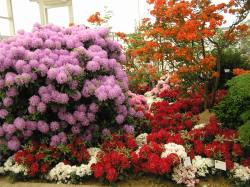
Pictures shows better than words the relaxed and friendly atmosphere that can be experienced in a visit to the BUGA in Koblenz. Although it might look just like a typical “theme park” with many “original” pavilions next one-another, this a minor and negligible aspect in front of the striking beauty of the landscape, the opportunity to relax and enjoy nature from several points of view.
The carefully designed and energy-efficient restoration of the “Festung Ehrenbreitstein” and the realisation of a brand new pavilion inside the fortress is another reason to visit the BUGA. I had this chance in occasion to the international expert seminar “Value Creation and New Business Models by Energy Efficiency Measures in Historic Buildings” held by the EVoCH network, European project dedicated to exploring the economical aspect of heritage restoration and management.
 Well Designed and Built