First Urbact Local Support Group Summer University in Krakow
Urbact is a European Community Program that brings together a large number of stakeholders of European urban policy making. I have been involved in Urbact Networks between 2005 and 2007 with the Hous-es project (about Regeneration of large housing estates in old and new member States) and since the beginning of 2011 in the Links project (about Future Proof Historical City Centers). My point of view is not the one of an external evaluator, but that of an independent researcher on urban policies and projects actively involved in the Program itself. Attending the first Urbact Local Support Group Summer University that took place in Krakow in September 29th to 31st was an opportunity for a renewed reflection about the Program and how it works.
For those who are not familiar with it, URBACT is an exchange and learning Program, part of european European Cohesion policy, born out of the wish to capitalise the experiences collected by the cities that implemented Urban and Urban II projects. Recognising the fact that the Urban approach established a “European way” to regeneration of deprived areas and urban development policies – a way that is necessarily different from the national and local urban policies – the first Urbact Program gave the opportunity to the cities who benefit from ERDF and ESF to reflect, exchange, capitalise and disseminate their experiences. The re-financing of the URBACT in 2007-2013 was preceded by an evaluation of the response by the cities and a survey of the result that had been achieved. On the basis of this analysis it was decided to continue the program as URBACT II providing it with more resources and increasing the percentage of EU funding for every partner city. On the other hand it was also decided to select the projects and the partner cities with severe criteria, to enlarge the scope of work of the networks and strengthen the monitoring of their activities.
Under URBACT II reflection and capitalisation are the basis for the production (and ideally implementation) of LOCAL ACTION PLANS (LAP) according to demands and analysis of the state of play made by the LOCAL SUPPORT GROUPS (ULSG). All URBACT II partners in Thematic Networks are required to elaborate a LAP as a consequence of the knowledge sharing process that takes place within the network and to respond to the demand and the suggestions that arises from the ULSG. The LAP should provide the city with a concrete roadmap and a range of solutions to tackle the issues identified at the beginning of the project. Furthermore, at Program level, the LAP shall represent a concrete output in the process of knowledge sharing and capitalisation.
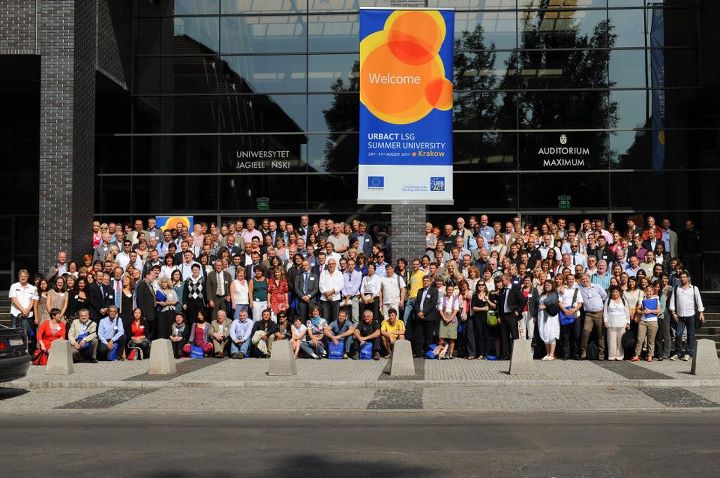
Group Picture in front of the Auditorium Maximum University Building
The First ULSG Summer University organised by URBACT II took place in Krakow and brought together more than 300 representatives of networks and Local Support Groups from all over Europe. The program of the event included short key-note speeches, lectures and interactive workshops about Local Support Group management, the so-called Urbact Cafè, allowing people from the same country or language to exchange in their native language and very few spare time to visit Krakow or meet with your Urbact friends. The work was supported by a fine tuned organisational management, extremely kind and competent polish language assistants and even a video team producing daily reports which are posted on the urbact dailymotion website. To watch some of these very nice videos you can click here, here, here and here. Wonderful!
This is all true, and there are many other interesting and exciting aspects of this undertaking that made worthwhile the significant effort required (2 and 1/2 days + travel). On the other side the main reason for this post is to focus on some issues that should be targeted in the next future to make a step forward towards URBACT III.
First of all the “Old Members States Supremacy”. I have no statistics about it, but it is evident that most activities at the Summer University were led and managed by representatives of the old member States. It reflects the fact that also most Networks and Experts are from these countries where eventually the largest Urbact knowledge and experience lies. It is clearly a situation that has developed this way in the years and I am sure that there is no discriminatory thinking behind it, but just some more work to be done at programme level in order to include more contributions by the ‘new’ Member States.
The second remark is related to the first one and I would call it the “English Supremacy”. Working, learning and exchanging with ideas means playing with words and this gives and conspicuous advantage to those who speaks in their mother language. Apparently a language is not only a way of expressing, but also a way of thinking and a channel for a specific cultural approach. This might become a problem for a program like URBACT which aims at putting in value the diversity of European cities (and cultures). Needless to say I love English language and culture and I have English for this blog in order to be able to communicate with colleagues at European and global level. Nevertheless we should always be aware of the language issue which becomes evident in occasions like the Summer University in Krakow.
The third and last issue I like to point out is also somehow linked to the previous ones and is about the fragmentation of these kind of learning events where you find yourself hustled from one room to another to listen, learn and experience things at a considerable speed. For smart professionals familiar with those kind of methodologies (and with their jargon) this might have been a refreshing and exciting exercise. But for some other average practitioner like myself that was sometimes frustrating. In other words I was missing some space to reflect and concentrate on the many issues raised. Of course you can download everything from the Urbact website, but this is not the same thing…
Finally there will be a lot of reporting on those intense days, a lot of homework to be done to become a better stakeholder, facilitator, public officer, planner etc. For the moment I just want to conclude this post with the pictures I took in the beautiful host city, from the airport to the University Guest-house in Florianska street and from there to the premises of the Summer University. That was on the day before the University began and we started our way on the path towards the Dragon’s Den!
Warsaw / 3 New Historic City

The capital city of Poland was razed to the floor by the Nazi Verbrennungs- und Vernichtungskommando (“Burning and Destruction Detachments”) after the uprising in late Summer 1944. While the Red Army was waiting outside the city, the Home Army was defeated after 65 days of battle. Ignoring the terms of capitulation Hitler ordered the expulsion of what remained of the population and destroyed 85% of the city, including the historic city center and the Royal Castle.
What we visit today is the result of the largest reconstruction project ever completed in the world. The whole historic city center (since 1980 listed among the Unesco World Heritage Sites) including its monuments is nothing but a careful replica of what it used to be before WWII. Visiting Warsaw you have to visit the historic city center and see how it works, apparently just like the original would do. It is the largest pedestrian area in the city, plenty of public buildings, restaurants and cafes, people walking and animating the space with all kind of public activities. In my Sunday walk I met a lot of polish families strolling down the city center, tourists, a political demonstration and the commemoration of some religious event, classical music (probably Chopin) in an open air cafe and many other small events that make this city center a lively and livable place.
Staying at a hotel in the so-called Centrum, which is actually a traffic loaded roundabout, I had to walk a while to reach the historic City centre, experiencing the juxtaposition of all kind urban spaces and building styles: reconstruction of ancient Churches, large prefabricated housing estates, rests of the old ghetto evidence of tragic events, public monuments and gardens from the communist era, contemporary office buildings, old comunist hotels refurbished by the western chains, esplanades etc.
Warsaw / 2 Palace of Culture and Science

It is said that after World War II Joseph Stalin asked representatives of the city of Warsaw what would they like to receive as a gift from the Soviet Union: a new Underground transport system or a Palace of Culture with Museums, Conference hall, Theaters etc. The pragmatic polish people answered they wished to build the Underground. Stalin took note and gave way to the project of the Palace of Culture and Science.
Confirming the fact that highrise buildings are powerful symbols of political authority under most political regimes and ideologies the tower at the center of this complex was the tallest building in Europe untill 1957 and remains still for a few months the tallest in the country, but the Palace of Culture and Science has far more interesting features than that. Works began in 1952 according to the plans of Russian architect Lev Rudnev who designed the plans for the Moscow State University and other relevant buildings of this period. 3500 workers were transferred from Russia, housed in a suburb of Warsaw and accomplished the complex in only three years in 1955.
Arriving in Warsaw the Palace of Culture and Science is still an impressive landmark and walking around it I was thinking about the strong appeal of such buildings on western travellers and particularly on architects. The big dimension, the building at urban scale, allowing multiple perspectives within a rigid symmetry; the peculiarity of the historical, economical and social context that brought to an artifact which is not replicable; the coherence of design; the use of labour intensive materials and technologies providing the pleasure of handicraft and materials that get better as they get old; the strange beauty of vernacular decoration, mixing up old and new decorative motifs without bitter postmodern reflections.
Nowadays the building complex is home to public and private offices, Museums, a multiplex Cinema, several Theaters, a convention center etc. A great resource for the city, despite the criminal mind of its initiator and the tragic rationale of its conception.
Arriving in Warsaw / 1 Streetviews
Arriving in a city you have never seen before is always thrilling, even if this city is not the most attractive touristic place of the country or a worldwide cultural magnet. I like to shoot random pictures right on the airport runway, from the window of a bus on the way to the city or at the first bus stop where I have to wait for the next tramway. Looking at these pictures it happens to discover things you haven’t seen before, other subjects instead of those you intended to shoot, nice composition you would not have thought about.
These pictures are taken on the way from the airport to the Hotel Polonia, located on the edge of a huge esplanade and transport hub called Centrum. Calling Centrum a major urban void surrounded by steel and glass highrise buildings and anonymous residential blocks is a masterpiece of disorientation. Since I don’t like to walk with my nose in a city map, I took it as a challenge, to walk around this Centrum and find my way to the Historical city centre, the pedestrian area I was advised to visit.
Ugo Rivolta European Housing Award 2011 Shortlisted Projects

The Jury panel of the of the 2011 Ugo Rivolta European Housing Award chaired by Peter Kis, winner of the last edition, met on May 31st to analyse the 51 projects submitted from 11 countries. The following 19 works were selected:
Austria/Vienna
Caramel Architekten Zt-Gmbh /Residential building at KrautgartenItaly/Bolzano
Christoph Mayr Fingerle /Complesso abitativo EA7Slovenia/Izola
Ofis Arhitekti /Honeycomb apartmentsFrance/Paris
Chartier – Corbasson Architectes /Logement sociaux, Rue de TurenneAustria/Vienna
Querkraft Zt-Gmbh Ksm /Karree St. Marx – Apartment buildingBelgium/Dison
Olivier Fourneau Architects /Social housing for FLWSpain/Terrassa
Flores & Prats /Building 111United Kingdom /London
Peter Barber Architects /Donnybrook QuarterUnited Kingdom /London
S333 Architecture + Urbanism /TarlingUnited Kingdom/London
Sergison Bates Architects /Urban housing, Finsbury ParkItaly/Milan
Consalez Rossi Arch.Ass., Vudafieri Saverino Partners, Francesca Peruzzotti, Andrea Starr/Stabile Abitare a Milano1, via CivitavecchiaSpain/Mieres
Zigzag Arquitectura Vivazz /Mieres Social HousingItalia/Milano
Mab Arquitectura /Edilizia sociale e parco urbano in via GallarateGermany/Cologne
Astoc Architects And Partners /Housing scheme Bucheimer WegGermany/Berlin
S.Zander, C.Roth, K.Fietzek, D.Gunkel, G.Neubeck, K.Scholtz, L.Tinius +Herrburg Landschaftsarchitekten Big yard – construction group project /Zelterstraße 5-11Spain/Begues
Jordi Farrando /18 Dwellings in BeguesThe Netherlands/Deventer
Kcap Architets & Planners /HoornwerkFrance/Pantin
Hamonic+Masson /36 Apartments and medical centreSwitzerland/Basel
Buhner Bründler Architects + Dipol Landscape Architects /Volta Residential Building
Concluding the session the Jury panel required that when submitting the documentation for the final stage project designers shall illustrate in detail the relationship of buildings and public spaces, common areas and non-residential spaces in general.
Definitive documentation shall be submitted no later than Tuesday 20th September. Final session of the jury will take place one week later at the Architects’ Chamber of Milan
 Well Designed and Built